Friday, August 21, 2009

Scandal: Little Joe Monaghan

Joe Monaghan rode into Ruby City, Idaho Territory, on a quality mare in 1867. Like others there, he was looking for a bonanza at the gold and silver mines to create a new life for himself. Unlike the others, he was too young to grow a beard, slight of stature, and didn't carry firearms.

Historian Mildretta Adams wrote, "A man could live a lifetime in the early days, known only by a nickname. His "handle" may have been acquired by an incident in his life, his profession, or some distinguishing characteristic. By the same token a man could live and work among others, and be accepted at face value, and no questions asked about the past."

The old-timers (those who'd managed to survive the harsh climate, high altitude, and heavy labor for a year), reckoned it would only be a matter of time before Little Joe headed back East with his tail between his legs, the same as most greenhorns.

The rugged men of Owyhee County scoffed at greenhorns throwing down their shovels and heading for softer country. Little Joe, however, soon earned the respect of even the toughest of men because even though the work was back-breaking, he never faltered. As it turns out, the backaches and the blisters on his hands, didn't faze him, but the scanty findings soon forced him to seek other work, as with so many other optimistic miners.

Soon, he quit his claim and went to work at odd jobs, then started raising small livestock and sold meat, milk, and eggs to the residents of Ruby City. He lived frugally in a small shack for several years, minding his own business and staying away from the bars and bawdy houses.

Eventually, he took the lonely job of a sheepherder; later, a cattle hand. Eventually he settled down on a homestead ten miles from Rockville, Idaho. A responsible citizen always, he never missed voting in an election and always served on juries and posses when called upon.

All along,he was known as an outstanding bronc buster as well as horse trainer, and wrangled the remuda on several roundups. He even performed as Cowboy Joe in Whaylen's Wild West Show: the Greatest Show on Land or Sea. Whaylen would pay $25 to any man who brought a horse that Joe couldn't ride.

But after a year, Joe couldn't tolerate city life any longer and went back home to Rockville, where his closest friend and only company was his Chinese cook. When the cook died, Joe became even more withdrawn from friends and neighbors. In late 1903, Joe took sick and died in January, 1904, of a coughing fit.

The neighboring ranchers came over to prepare him for burial. But . . .

He was a SHE! The tough old ranchers had been fooled for over 30 years. Little Joe Monaghan, the miner, bronc buster, and rancher, was a woman. The tiny town of Rockville was, well, rocked. News spread far with headlines splashed on newspapers across the nation.

No one knows for sure exactly who Joe was. Anna Walters in Buffalo, NY, claimed the Joe was actually Johanna Monaghan and at age eight, had been adopted by the Walters family. They had a picture of Joe with short hair, in masculine attire. Another possibility is the theory that Joe was a Buffalo, NY, debutant who bore an illegitimate son and was disowned by her family. Joe's sister raised the child, Laddie, who grew up to become a lawyer.

Either premise is plausible--neither can be proved or disproved.

Joe was buried in the local cemetary at the Hat H Ranch near Rockville. She took her secrets with her, leaving us to speculate what made a lovely young woman chose to live and die in one of the roughest of lifestyles.

Sources:

Websites
Owyhee County History

Books:
More Than Petticoats: Remarkable Idaho Women
Lynn E. Bragg

Historic Silver City: The Story of the Owyhees
by Mildretta Adams
Owyhee Publishing Co., Inc., 1969 (tenth printing 1999)

Jacquie

Down Home Ever Lovin' Mule Blues (See the Book Video featuring Justin Saragueta) Jacquie Rogers * 1st Turning Point * Myspace * Twitter * Facebook Faery Special Romances * Book Video * Royalties go to Children's Tumor Foundation, ending Neurofibromatosis through research.

Tuesday, June 23, 2009

Places You've Never Heard Of: Silver City, Idaho

It was 1863 in the Owyhee Mountains located in the southwest corner of Idaho Territory. The War Between the States raged in the east, but out west, men had dollar signs in their eyes, looking for that next bonanza. They could get rich raising cattle, or logging, but fastest of all, gold. And silver.

The mining boom town of Ruby City was formed--a hotel, several business and residents, and the county seat. A few years later, Silver City sprang up as well. Ruby City hung on for a while but after a series of floods and a few other things that went haywire, the Idaho Hotel and the county seat were moved to Silver City.

Silver City was born on mining. Silver mine tunnels numbered in the hundreds, and dotted the countryside as well as the city. Here's a pan view of Silver City I found you YouTube. There's even a mine under the church! 60 million dollars worth of silver was taken in the 1900s, and if converted to today's currency, that would be a whole lot more for this little area. The silver lodes were the richest in Idaho Territory.

Historic Silver City Idaho writes:
During its "heydays", Silver City had about a dozen streets, seventy-five businesses, three hundred homes, a population of around 2,500, twelve ore-processing mills, and was the Owyhee County seat from 1866 to 1934. Some of the largest stage lines in the West operated in the area, and Silver City had the first telegraph and the first daily newspaper in the territory in 1874. Telephones were in use here at least by 1880, and the town was "electrified" in the 1890's.

(Picture to the left: the bar at the Idaho Hotel.)

Never heard of it? Most people haven't, but it was truly the wild west in all manner of ways. It's located in Owhyee County, which is a large county in southwest Idaho. The newspaper they refer to is The Owyhee Avalanche, the longest operating newspaper in Idaho and one of the oldest in the West. I subscribe to it--it's a very high quality publication. There was never a shortage of news from the tough men who risked their lives in the mines every day for the promise of a life of luxury.

From The Owyhee Avalanche, October 17, 1868:
SHOOTING SCRAPE
Between seven and eight o'clock last Monday evening a shameful shooting affar occurred at Sommercamp's saloon, between two of our citizens. On account of the hitherto respectability of the parties and for the sake of their friends we suppress names. On the evening in question, we, together with the twenty-five or thirty others were in the saloon, when the two valiant shootists commenced banging away at each other with revolvers . . .
Silver City and the surrounding ore-rich area drew men from all over the world to mine the silver lodes. Many Chinese came to make their fortunes, and several did. Of course, as with the Anglo immigrants, most didn't. Still, the Chinese established a strong presence and the economy couldn't have survived without them. Not that there weren't a few problems along the way:

From The Owyhee Avalanche, October 17, 1868:
MORE SHOOTING
Last Tuesday night a Chinaman was shot and severely wounded in a Chinese gambling house on Jordan Street. It appears a Chinaman who was bucking at a game wanted to bet five dollars on jaw-bone, the dealer objected, the other fell back on his dignity and shot the almond-eyed gamboiler through the right shoulder. The next day we noticed Deputy Sheriff John Springer and a posse of mounted Chinamen hunting for the shootist. We learn from Dr. White, who is attending the wounded Chinaman, that he will get well.
And yes, there were Cyprians--the ladies of the evening. Men out-numbered women at one point by 200 to 1 so every woman, no matter what her status, was highly regarded. The women, however were not so impressed with one another.

From The Owyhee Avalanche, February 26, 1870:
FEMALE PUGLISTS
One evening this week be observed two frail females in the vicinity of Catalow's stable, engaged in commintting assault and battery upon each other. For some time the fur flew in all directions. The finally sank down in the snow through sheer exhaustion. Jealousy was the cause of the muss.
And, yes, confrontations with the Indians were frequent. Be warned, this next quote is even worse than the one about the Chinese. "Politically Correct" was not yet invented. But we must also avoid revisionist history--Anglos were, for the most part, of the opinion that Native Americans were sub-human. This is why I avoid the entire issue in my westerns. I write humor and there isn't anything the least bit humorous about the treatment of the Indians.

From The Owyhee Avalanche, September 12, 1868:
LO THEY COME!
Tho's H. Smith Esq. just in from Camp Three Forks, informs us that last week the military of that place gobbled up and brought into Camp six-teen Indians as prisoners. Under promise of bringing in for-teen more, three bucks, whose squaws were retained as hostages, were allowed to go out into the mountains. The miserable wretches profess a desire to give themselves up and stop robbing and scalping the whites--at least till they recruit and obtain a fresh supply of arms and ammunition.
Silver City was difficult to get to and from (travel can get a bit dicey even today), so the subject of roads was always prominent in the news. Keep in mind "highways" is a subjective term here. The road into Silver City from the east isn't two-lane all the way even now. It's a dirt road and depending on the season, you drive on the high side of the ruts in order not to high center your vehicle. In those days, horses, stagecoaches, and wagons traveled the very same road.

From The Owyhee Avalanche, May 16, 1868:
THE ROADS
We are pleased to know that Mr. Abbott, Supervisor for the Road District No. 2, has commenced repairing the roads. As a consequence of the ground's thawing out and the melting of the snow, our highways in many places were in bad condition, but now the ground is becoming dry and the money now on hand in the road fund, with the taxes yet to be collected for that purpose will serve to put the roads in good order.
But most of all, people need entertainment, and the residents of Silver City weren't any different. There was a theater, several saloons, and lots of parties and receptions at the I.O.O.F Hall. In the dark of winter, entertainment was even more sought after.

From The Owyhee Avalanche, January 4, 1868:
ON WITH THE DANCE!
seems to be the motto just now--just what we expected, as soon as it became known on the outside that times were lively and money plenty in Owyhee, in comes a batch of hurdies to gobble up their share. It is an easy matter to find out where the hold forth --watch the crowds of suffering manhood as they emerge from cabins along the creek in the dusky twilight, or silently wend their way, in Indian file, down the mountainside; their steps are directed to Gabriel's large building, corner of Jordan and Second Sts., where, seated on a bench at one side of the spacious hall, are four coy and blushing damsels. . .

Jacquie
Down Home Ever Lovin' Mule Blues (See the Book Video featuring Justin Saragueta) Jacquie Rogers * 1st Turning Point * Myspace * Twitter * Facebook Faery Special Romances * Book Video * Royalties go to Children's Tumor Foundation, ending Neurofibromatosis through Research

Read a book by Jacquie Rogers

Wednesday, June 3, 2009

Where the Heck is Grasmere, Idaho?

In fact, whoever heard of Grasmere, Idaho?

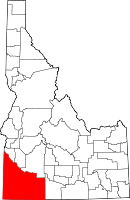
It's in Owyhee County, located in the southwest corner of Idaho. This is one of the largest counties in the lower 48 states, and has about the same area in square miles as New Jersey. Population is a about 1 person per square mile (twice as many people as when I lived there), although far less dense than that around Grasmere. (New Jersey's population density is about 1,170 people per square mile.) You'll find Grasmere . . .

South of Grandview.
Farther south of Murphy.
Way south of Marsing.
And way, way south of Homedale.
North of the Duck Valley Indian Reservation.

This is what Grasmere looks like.


At the bottom of the page, you'll see my fictional world of Grasmere.


My editor was a bit stunned when I told her that there are twice as many characters in Down Home Ever Lovin' Mule Blues as there is actual population in Grasmere, Idaho, where the story is set. Last I knew, Grasmere had phone service but not electricity, and outlying ranches have neither. All appliances and electrical devices are run with generators or propane.

In high mountain desert, Grasmere's elevation is a mile high: around 5,200 feet. Precipitation is scarce, about 8" per year, so even though the altitude is high, Grasmere ususally only receives less than a foot of snow total--a dusting here and there that blows away with the incessant, biting wind. In the summer, there is no wind at all, sometimes not a hint of a breeze. Temperatures can get up into the 100's, although average temperature in August is only 86 degrees.

So who lives In Grasmere? I'm not sure, at this point. Grasmere is a city with a post office, but last I knew, only one family lived in the city proper, and they were looking for a buyer. The buildings there are: restaurant/gas station/post office, a house, a garage, and I think a shed. Take a look at the Mapquest Aerial Map.

And exactly why did I set Down Home Ever Lovin' Mule Blues in Grasmere? Because I wanted to make communication a little more difficult, the lifestyle more contrasting to the urban life, and my heroine just a little bit ashamed of her roots. In fact, that's her external character arc, to become proud of her family, her roots, her childhood home. To contrast that, the hero comes from an urban family and settles in one of the most rustic places he can find. His external character arc is to learn that happiness comes from what and who you are, not where you live.

I just don't see how this story could have worked anywhere else. The long drive to the hospital, the infrequent shopping trips to the city, and whole joke about Triangle--these elements are integral to the story.

And, as promised, here's the fictionalized Grasmere:


To get an idea of how I envisioned the story world, take a look at the book video.

How important is setting to you? Let me know and you could win an autographed copy of Down Home Ever Lovin' Mule Blues and a Mule Blues T-shirt (USA mailing only. All others responsible for postage.)

This is a Classic Romance Revival GROUP event. You MUST have commented on EACH and EVERY blog in order to qualify for a prize. To see the contest rules and other prizes and to find more fabulous blogs, please go to:


(Don't forget to include your email address when you make comments here and at the other sites, so we can reach you in case you win!)

Cheers!

Jacquie
Down Home Ever Lovin' Mule Blues (See the Book Video featuring Justin Saragueta)
Jacquie Rogers *** Myspace *** Twitter *** Facebook

Faery Special Romances * Book Video * Royalties go to Children's Tumor Foundation, ending Neurofibromatosis through Research

Read a book by Jacquie Rogers

Monday, May 18, 2009

One-Room Schoolhouses

by Jacquie Rogers
Copyright© 2011 Jacquie Rogers

One-room schoolhouses were the norm in 19th Century America, especially in the rural areas. In the West, they lingered on for many decades more, into the mid-20th Century. A one-room school in the area where I grew up closed in the late 1950s, and I remember that even years later, many residents mourned its closing.

Why were one-room schoolhouses so successful?

In a word: efficiency. All the children attended one school, so the townspeople could put their expendable resources into a single source of education. The building was generally used for other purposes as well, such as town council meetings, court room procedings, and sometimes church services. This concentration of resources enabled a small town to offer much more in the way of civic services than would otherwise be possible.

How did these schools operate?

In some districts, a trustee was appointed. His job was to hire the schoolteacher, acquire supplies, keep the building in good repair, and oversee any contentious situations. Other district elected a school board to do these jobs.

Students numbered from 5 to 50. One schoolteacher could handle many children because older childern mentored the younger children. While the schoolteacher was working with one grade, the other students were studying, unually together. And of course the older students learned well since they also taught the lessons.

Children also did chores--cleaning the blackboard, sweeping, hauling in wood, and all the general duties required to keep a building in operation. Many times, a chore was an award for a job well done.

Most schoolteachers were female, young, single, and well-spoken, which meant they attracted young men. The trustee never knew if one of the young farmers would steal their schoolmarm out from under their noses. It happened. A lot. A this is probably why rules for schoolteachers came about.

Not all schools used these rules, but I did find them associated with schools on the East and West Coasts, and all the way through the Midwest. From New Hampshire Historical Society:

Rules for Teachers
  1. You will not marry during the term of your contract.
  2. You are not to keep company with men.
  3. You must be home between the hours of 8 p.m. and 6 a.m. unless attending a school function.
  4. You may not loiter downtown in ice cream stores.
  5. You may not travel beyond city limits unless you have the permission ofthe chairman of the board.
  6. You may not ride in a carriage or automobile with any man unless he is your father or brother.
  7. You may not smoke cigarettes.
  8. You may not dress in bright colors.
  9. You may under no circumstances dye your hair.
  10. You must wear at least two petticoats.
  11. Your dresses must not be any shorter than two inches above the ankle.
  12. To keep the school room neat and clean, you must:
sweep the floor at least once daily;
scrub the floor at least once a week with hot, soapy water;
clean the blackboards at least once a day;
start the fire at 7 a.m. so the room will be warm by 8 a.m

I wonder who was in charge if checking her petticoats.

Have a great day!

Jacquie
Down Home Ever Lovin' Mule Blues (See the Book Video featuring Justin Saragueta)
Jacquie's website * 1st Turning Point * Twitter * Facebook
Faery Special Romances *Royalties to Children's Tumor Foundation, ending Neurofibromatosis through Research


Read a book by Jacquie Rogers

Wednesday, March 11, 2009

Contest: Author Jane E. Jones

This is from my friend and sister Texty Lady, Jane E. Jones:

Hi everybody! This week I’m giving away a romance themed gift bag, with two ways to be entered to win.


All you have to do to for your chance to win is buy a copy of Puppy Love, or post this contest on your blog, myspace, facebook, etc. If you buy a book AND blog this contest, you’ll get two entries.


If you buy the book, just email a copy of your purchase receipt to
janejane07 @ gmail . com (take out the spaces). If you blog the
contest, leave me the link in comments. That’s it! You’ll then be
entered to win a gift bag full of goodies:


Four DVD movies-The Phantom of the Opera (Gerard
Butler), Music and Lyrics (Hugh Grant and Drew Barrymore), The
Sisterhood of the Traveling Pants (Ernie Lively), and Divine Secrets of
the Ya-Ya Sisterhood (Sandra Bullock).


An adorable furry stuffed animal


Sweet Treats-Chocolate, anyone?


A scented candle


Two bags of microwave popcorn-to munch while you watch the movies :)


A cute little striped notebook


A Pair of fuzzy socks


And maybe a couple other extras that I pick up along the way.


The contest ends March 23 at midnight EST time; I’ll announce a winner on Tuesday, March 24.


To buy Puppy Love, click here.


Good luck!


~Jane


Monday, March 9, 2009

Texty Ladies special guest: John Klawitter


A Man of All Media at Texty Ladies


Please join producer, director, screenwriter, ad man, and award-winning author John Klawitter at Texty Ladies, where he gave us an interview and promised more to come later! John has done everything from jingle writing (Nestles makes the very best. . . choc-lit), to Disney movie trailers, with a few stops in between--penning the biography of football superstar Deacon Jones, as well as writing novel-length fiction.

http://www.textyladies.com/?p=333

And what a grand day! John won two EPPIE Awards!

EPPIE Award Winner John Klawitter


See you at Texty Ladies!


Jacquie

Down Home Ever Lovin' Mule Blues (See the Book Video featuring Justin Saragueta)
Jacquie Rogers *** Myspace *** Twitter *** Facebook

Faery Special Romances *** Book Video
Royalties go to Children's Tumor Foundation, ending Neurofibromatosis through Research

Read a book by Jacquie Rogers