Showing posts with label old west. Show all posts

Friday, November 7, 2014

Where the heck is Silver City, Idaho? #western #ghosttown #books #romance


It was 1863 in the Owyhee Mountains located in the southwest corner of Idaho Territory. The War Between the States raged in the East, but out West, men had dollar signs in their eyes, looking for that next bonanza. They could get rich raising cattle, or logging, but fastest of all, gold. And silver.

The mining boom town of Ruby City was formed--a hotel, several businesses and residents, and the Owyhee County seat. A few years  and a few floods later, Silver City sprang up just down Jordan Creek. Ruby City hung on for a while but after another big flood, and a few other things that went haywire, the Idaho Hotel and the county seat were moved to Silver City.

Silver City was born on mining. Silver mine tunnels numbered in the hundreds, and dotted the countryside as well as the city. Here's a pan view of Silver City I found on YouTube. There's even a mine under the church! Sixty million dollars worth of silver was taken in the 1900s, and if converted to today's currency, that would be a whole lot more for this little area. The silver lodes were the richest in Idaho Territory.
The bar at the Idaho Hotel
Historic Silver City Idaho writes:
During its heyday, Silver City had about a dozen streets, seventy-five businesses, three hundred residences, a population of around 2,500, twelve ore-processing mills, and was the Owyhee County seat from 1866 to 1934. Some of the largest stage lines in the West operated in the area, and Silver City had the first telegraph and the first daily newspaper in Idaho Territory as of 1874. Telephones were in use there at least by 1880, and the town was "electrified" in the 1890's.
Never heard of it? Most people haven't, but it was truly the wild west in all manner of ways. It's located in Owhyee County, which is a large county in southwest Idaho. The newspaper they refer to is The Owyhee Avalanche, the longest operating newspaper in Idaho and one of the oldest in the West. I subscribe to it--it's a very high quality publication. There was never a shortage of news from the tough men who risked their lives in the mines every day for the promise of a life of luxury.

From The Owyhee Avalanche, October 17, 1868:
SHOOTING SCRAPE
Between seven and eight o'clock last Monday evening a shameful shooting affar occurred at Sommercamp's saloon, between two of our citizens. On account of the hitherto respectability of the parties and for the sake of their friends we suppress names. On the evening in question, we, together with the twenty-five or thirty others were in the saloon, when the two valiant shootists commenced banging away at each other with revolvers . . .
Silver City and the surrounding ore-rich area drew men from all over the world to mine the silver lodes. Many Chinese came to make their fortunes, and several did. Of course, as with the Anglo immigrants, most didn't. Still, the Chinese established a strong presence and the economy couldn't have survived without them. Not that there weren't a few problems along the way:

From The Owyhee Avalanche, October 17, 1868:
MORE SHOOTING
Last Tuesday night a Chinaman was shot and severely wounded in a Chinese gambling house on Jordan Street. It appears a Chinaman who was bucking at a game wanted to bet five dollars on jaw-bone, the dealer objected, the other fell back on his dignity and shot the almond-eyed gamboiler through the right shoulder. The next day we noticed Deputy Sheriff John Springer and a posse of mounted Chinamen hunting for the shootist. We learn from Dr. White, who is attending the wounded Chinaman, that he will get well.
And yes, there were Cyprians--the ladies of the evening. Men out-numbered women at one point by 200 to 1 so every woman, no matter what her status, was highly regarded. The women, however were not so impressed with one another.

From The Owyhee Avalanche, February 26, 1870:
FEMALE PUGLISTS
One evening this week be observed two frail females in the vicinity of Catalow's stable, engaged in commintting assault and battery upon each other. For some time the fur flew in all directions. They finally sank down in the snow through sheer exhaustion. Jealousy was the cause of the muss.
And, yes, confrontations with the Indians were frequent. Be warned, this next quote is even worse than the one about the Chinese. "Politically Correct" was not yet invented. But we must also avoid revisionist history--Anglos were, for the most part, of the opinion that Native Americans were sub-human, which is why I avoid the entire issue in my westerns. I write humor and there isn't anything the least bit humorous about the treatment of the Indians.

From The Owyhee Avalanche, September 12, 1868:
LO THEY COME!
Tho's H. Smith Esq. just in from Camp Three Forks, informs us that last week the military of that place gobbled up and brought into Camp six-teen Indians as prisoners. Under promise of bringing in four-teen more, three bucks, whose squaws were retained as hostages, were allowed to go out into the mountains. The miserable wretches profess a desire to give themselves up and stop robbing and scalping the whites--at least till they recruit and obtain a fresh supply of arms and ammunition.
Silver City was difficult to get to and from (travel can get a bit dicey even today), so the subject of roads was always prominent in the news. Keep in mind "highways" is a subjective term here. The road into Silver City from the east isn't two-lane all the way even now. It's a dirt road and depending on the season, you drive on the high side of the ruts in order not to high-center your vehicle.  If you see another car coming, you pull over in a wide spot to let them pass. In those days, horses, stagecoaches, and wagons traveled the very same road.

From The Owyhee Avalanche, May 16, 1868:
THE ROADS
We are pleased to know that Mr. Abbott, Supervisor for the Road District No. 2, has commenced repairing the roads. As a consequence of the ground's thawing out and the melting of the snow, our highways in many places were in bad condition, but now the ground is becoming dry and the money now on hand in the road fund, with the taxes yet to be collected for that purpose will serve to put the roads in good order.
But most of all, people need entertainment, and the residents of Silver City weren't any different. There was a theater, several saloons, and lots of parties and receptions at the I.O.O.F Hall. In the dark of winter, entertainment was even more sought after.

From The Owyhee Avalanche, January 4, 1868:
ON WITH THE DANCE!
seems to be the motto just now--just what we expected, as soon as it became known on the outside that times were lively and money plenty in Owyhee, in comes a batch of hurdies to gobble up their share. It is an easy matter to find out where the hold forth --watch the crowds of suffering manhood as they emerge from cabins along the creek in the dusky twilight, or silently wend their way, in Indian file, down the mountainside; their steps are directed to Gabriel's large building, corner of Jordan and Second Sts., where, seated on a bench at one side of the spacious hall, are four coy and blushing damsels. . .

Such is the rich lode of Idaho history that I mine in my Hearts of Owyhee series.  The newspapers use interesting language--plain-spoke but flowery, and the terms are just plain fun.  And this week, I hope to make it to the Idaho Archives and collect even more.  More, more, more!
 Hearts of Owyhee 
Where the Old West really happened!

Much Ado About Marshals
Much Ado About Madams
Much Ado About Mavericks
Much Ado About Miners

Sunday, December 18, 2011

Winter Festivities in the Old West


by Jacquie Rogers
Yule Brings Celebration For All

The snow blows nearly sideways as it blankets the range. Ranch hands hunker down in their saddles, scarves over their ears and their Stetsons protecting them from the fierce wind. They dream of a warm fire and hot buttered rum. But they have livestock to save from freezing and starvation, so they ride on.

It's Christmas on the open range. Miserable for man and beast. But it isn't just another day at the office, so to speak. They whittle gifts for one another, sing a few carols as they sit around the campfire warming their hands and feet. Cook gives them a hot meal--the finest beans with maybe some meat thrown in. And with a little luck, Cook would bake an apple pie. Life couldn't be better and they thank their lucky stars for a sound horse and solid tack.

(Yes, I know these cattle are a modern breed and very fat, but it's the only picture I could find.)


Ahavath Beth Israel Congregation

Chanukkah in the mines

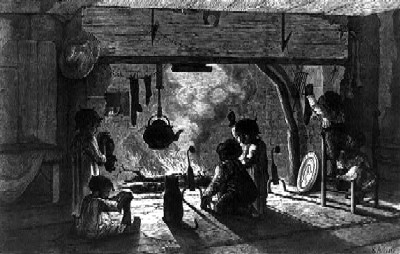
It's the 1860's in Silver City, Idaho. The Festival of Lights has been celebrated in the West since the beginning of frontier settlement, but not like their counterparts back East who have a warm and dry place to worship with their families. A menorah can be lit anywhere, and the Jewish silver miners do just that. They pray, play a little dreidel, and think a lot of home.

The picture to the left is the oldest continuously used synagogue west of the Mississippi. It's located in Boise, Idaho, and was built in 1896 by the Beth Israel congregation, now called the Ahavath Beth Israel congregation. Very beautiful.

Christmas on the farm

Everyone has chores to do every day. Cows needs milked, livestock needs watered and fed, eggs need gathered, and the barnyard needs to be tidied (to use a gentile term). So after the chores are done, the family can gather together and celebrate Christmas with what meager resources they have. If they don't have evergreen trees to spare, they might decorate a sagebrush with popcorn and berries. They make ornaments with precious bits of paper and scraps of cloth. Peach tins make nice ornaments, too, and they shine in the firelight.


1876 Christmas, Harper's Weekly

Their celebration might be more humble than those in the eastern cities, but they have a grand time, nevertheless. The women cook for days. They're resourceful and whatever they have available will do for a fine pie or stew. The Christmas feast could consist of chicken, venison, or maybe a ham, along with homemade rolls, freshly churned butter, potatoes and gravy, and pies--maybe one made with dried apples and a vinegar pie. Each family member has made modest gifts for the others and even the smallest child has labored over precious gifts--maybe a drawing or a doll made of sticks. They sing carols, maybe read the Bible, and if they're close enough to town, maybe even go to church.

For most Christian families, Christmas is a day for family togetherness and to show their love and appreciation for one another, as well as celebrating the religious aspect of the holy day.

Christmas for Outlaws, Gunslingers, and Cyprians

The saloon owner brings small gifts for the working ladies, the bartender, the resident gambler, and a few of the regulars. A few cowpunchers bring gifts for their favorite girl. They might have a nice meal together before they open for business, and even then, the customers are few. It's one night they can relax.

Happy Holidays to Everyone!

My gift to you: send a message to jacquierogers @ gmail.com (no spaces) and let me know which book you'd like, Faery Merry Christmas or Much Ado About Marshals and I'll send you a Smashwords coupon for a free book.  Offer ends 10pm Pacific Time, December 19th.

Sunday, February 6, 2011

Much Ado About Marshals

Wow, July 2011 is coming up fast! Why am I so excited? Because my next release, Much Ado About Marshals, will be released mid-July in trade paperback (a month earlier in ebook, I hope!). This book has a fabulous cover. You know it would be fabulous because the multi-talented Deborah Macgillivray is the cover artist. Wanna sneak peek? :)


With a little luck, I might get the cover model to agree to an interview. Should I?

Jacquie
Down Home Ever Lovin' Mule Blues (See the Book Video featuring Justin Saragueta)
Website *** Myspace *** Twitter *** Facebook
Faery Special Romances *** Book Video
Royalties go to Children's Tumor Foundation,
ending Neurofibromatosis through Research

Friday, April 9, 2010

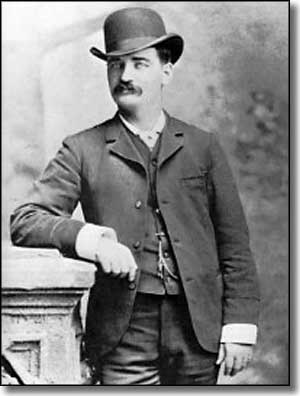
Bat Masterson--Sports Writer


“Bat Masterson said he didn't know anybody Wyatt couldn't whip without his guns. A lot of times Wyatt didn't carry guns...because if he carried guns he had to kill somebody - and he would kill somebody - but he didn't want to. He was a very religious man.”

When we think of Bat Masterson, most of us envision a lawman, a gunfighter--a man's man in the Old West. The television series definitely promoted that image. But did you know that he was also a New York sports writer?

Yep. Not only did he end up being a sports writer, but he wrote for years--as a newspaper reporter and editor as well as for other periodicals--and he'd been doing so since he was a young man. In fact, his ability to write and promote himself is how he pretty much created his own legend.

It all started in Quebec, Canada, on November 26, 1853, when a baby boy named Bartholomew Masterson was born Irish parents. In his teens, the family moved to Wichita, Kansas, and he along with his two of his brothers, Ed and James, went off to seek their fortunes as so many other boys did--buffalo hunting. At age 20, he fought in the Second Battle of Adobe Walls, and then worked for a while as a U.S. Army scout. From 1876 to 1882, he did his gunfight/lawman gig where he rose to notoriety, but our story starts in 1883.

It seems Bat rather enjoyed the sport of boxing. A lot. He was obsessed with fights and was more than fair at pre-fight analysis as well as calling the winners. So good, in fact, that he wrote a sports column for a Denver newspaper called George's Weekly. Newspapermen (and brothers) A.H. and W.E. Lewis had befriended Bat in Kansas City ten years before, and they would play a prominent role in Bat's fame and later success in the East. With their help, he'd honed his writing skills and while he couldn't be called a literary giant, he was pretty good at the craft.

During the years between his gunfighting days and his newspaper career, he mixed a little law enforcement here and there with gambling and writing. He was a professional gambler (called a thoroughbred) and organized boxing matches, acted as referee at times, as bookie, and guard. He never did actually box himself, though. His predictions were often right on, and he was excellent at assessing the fighters, their physical abilities, talent, and motivation.

Bat's life wasn't all roses. He ended up in more than a few altercations when his past reputation would catch up with him, and after a while, also succumbed to the lure of alcohol, although he threw off the demon when he moved to Manhattan. The buzz of New York City suited him just fine and he loved living there. Who would have thought a crusty old gunfighter would take so quickly to city life?

He hooked up with the Lewis brothers again, and he wrote for the New York Morning Telegraph, where he eventually because vice president and secretary. He was close friends with Teddy Roosevelt and other notables, and lived well for the rest of his days.

In 1821, he was writing his column when he had a heart attack and died hunched over his typewriter. The last thing he wrote was, "There are those who argue that everything breaks even in this old dump of a world of ours. I suppose these ginks who argue that way hold that because the rich man gets ice in the summer and the poor man gets it in the winter things are breaking even for both. Maybe so, but I'll swear I can't see it that way."

His last words are evidence that our world really hasn't changed much.

Jacquie
Faery Merry Christmas (a Kindle novella)
Down Home Ever Lovin' Mule Blues (See the Book Video featuring Justin Saragueta)
Jacquie's website * 1st Turning Point * Myspace * Twitter * Facebook
Faery Special Romances * Book Video * Royalties go to Children's Tumor Foundation, ending Neurofibromatosis through Research

Read a book by Jacquie Rogers

Monday, May 18, 2009

One-Room Schoolhouses

by Jacquie Rogers
Copyright© 2011 Jacquie Rogers

One-room schoolhouses were the norm in 19th Century America, especially in the rural areas. In the West, they lingered on for many decades more, into the mid-20th Century. A one-room school in the area where I grew up closed in the late 1950s, and I remember that even years later, many residents mourned its closing.

Why were one-room schoolhouses so successful?

In a word: efficiency. All the children attended one school, so the townspeople could put their expendable resources into a single source of education. The building was generally used for other purposes as well, such as town council meetings, court room procedings, and sometimes church services. This concentration of resources enabled a small town to offer much more in the way of civic services than would otherwise be possible.

How did these schools operate?

In some districts, a trustee was appointed. His job was to hire the schoolteacher, acquire supplies, keep the building in good repair, and oversee any contentious situations. Other district elected a school board to do these jobs.

Students numbered from 5 to 50. One schoolteacher could handle many children because older childern mentored the younger children. While the schoolteacher was working with one grade, the other students were studying, unually together. And of course the older students learned well since they also taught the lessons.

Children also did chores--cleaning the blackboard, sweeping, hauling in wood, and all the general duties required to keep a building in operation. Many times, a chore was an award for a job well done.

Most schoolteachers were female, young, single, and well-spoken, which meant they attracted young men. The trustee never knew if one of the young farmers would steal their schoolmarm out from under their noses. It happened. A lot. A this is probably why rules for schoolteachers came about.

Not all schools used these rules, but I did find them associated with schools on the East and West Coasts, and all the way through the Midwest. From New Hampshire Historical Society:

Rules for Teachers
  1. You will not marry during the term of your contract.
  2. You are not to keep company with men.
  3. You must be home between the hours of 8 p.m. and 6 a.m. unless attending a school function.
  4. You may not loiter downtown in ice cream stores.
  5. You may not travel beyond city limits unless you have the permission ofthe chairman of the board.
  6. You may not ride in a carriage or automobile with any man unless he is your father or brother.
  7. You may not smoke cigarettes.
  8. You may not dress in bright colors.
  9. You may under no circumstances dye your hair.
  10. You must wear at least two petticoats.
  11. Your dresses must not be any shorter than two inches above the ankle.
  12. To keep the school room neat and clean, you must:
sweep the floor at least once daily;
scrub the floor at least once a week with hot, soapy water;
clean the blackboards at least once a day;
start the fire at 7 a.m. so the room will be warm by 8 a.m

I wonder who was in charge if checking her petticoats.

Have a great day!

Jacquie
Down Home Ever Lovin' Mule Blues (See the Book Video featuring Justin Saragueta)
Jacquie's website * 1st Turning Point * Twitter * Facebook
Faery Special Romances *Royalties to Children's Tumor Foundation, ending Neurofibromatosis through Research


Read a book by Jacquie Rogers

Monday, January 14, 2008

Thursday Thirteen: Farm Chores before Breakfast

What Do You Do Before Breakfast?

In the Old West, farm chores lasted from dawn to dark, and even after dark, mending clothes, soaping leather, and that sort of thing still had to be done. This list is typical of what a family would expect to accomplish before breakfast. The day starts just before first light, and remember, they didn't have central heat.

1. Start the fire in the stove.
2. Pump water/heat water for washing, get dressed.
3. Feed the chickens.
4. While hens are occupied, gather eggs.
5. Pitch hay to the horses.
6. While horses are occupied, check for injuries and clean the stalls.
7. Grain the steers.
8. Grain the cows and milk them. (This counts for all 13. You wouldn't believe how tired your hands get.)
9. Separate the milk, store milk and cream in the spring house, wash the buckets.
10. Feed the pigs and nursing calves.
11. Pump water for all the animals.
12. Get the field equipment ready so you can hitch the horses as soon as breakfast is over.
13. Wash up and cook breakfast.

Even today, farmers have to do about half these chores before breakfast, but electricity has definitely made watering animals and milking cows much easier.

Farm breakfasts were no meager affair. A typical menu might be bacon, fried eggs, fried potatoes, biscuits and gravy, strawberry preserves, oatmeal and cream, and coffee. Then again, they had worked up quite an appetite. Besides, after breakfast, the hard work began.

Ah, I do love living in the 'burbs!

Valentine's Day Contest: Tell me your own faery special romance and you could win cool prizes! Details on the contest page of my website.

Jacquie

Princess Keely, Star of Faery Special Romances

Jacquie Rogers *** Myspace *** Bebo *** Faery World

Faery Special Romances (see the book video)

Royalties go to Children's Tumor Foundation,
ending Neurofibromatosis through Research

Coming soon: Down Home Ever Lovin' Mule Blues

Monday, October 1, 2007

Bounty Hunters in the Old West

The law was a bit sparse in the Old West, often not a lawman around for hundreds of miles. If a criminal knew how to live off the land and he owned a fast horse, he was pretty well guaranteed an escape. What's a sheriff to do?

In 1872, the Supreme Court ruled that bounty hunters were a part of the U.S. law enforcement system with a decision in Taylor vs. Taintor:

“When the bail is given, the principal is regarded as delivered to the custody of his sureties. Their domain is a continuance of the original imprisonment. Whenever they choose to do so, they may seize him and deliver him up to his discharge; and if it cannot be done at once, they may imprison him until it can be done. They may exercise their rights in person or by agent. They may pursue him into another state; may arrest him on the Sabbath; and if necessary, may break and enter his house for that purpose. The seizure is not made by virtue of due process. None is needed. It is likened to the arrest by the Sheriff of an escaped prisoner.”

As you can see by this decision, bounty hunters didn't have to adhere to the same rules of due process that lawmen did. (This is still true in some states.)

One of the greatest bounty hunters was Pinkerton Detective, Charlie Siringo. Siringo had a long and distinguished, if not controversial, career. He had steely nerves and his cleverness got him out of more than one jam. But he wrote a book, and the Pinkerton Agency wasn't too keen about that, so he spent several years at the end of his life arguing with them. Could be that the Pinkertons were the only ones to ever best him.

Lots of town marshals and county sheriffs supplemented their meager incomes with bounties. Of course, they had to follow the rules of due process while a bounty hunter had no such restrictions. Then again, if there's no one around for a couple hundred miles, who's to know? This is part of how the West was tamed. Many lawmen straddled the fence between law-enforcing and law-breaking.

Charlene Sands, author of Bodine's Bounty, blogged about bounty hunters on Pistols and Petticoats. Really good info at this site on lots of Old West topics. Anyway, she points out that in order for a bounty hunter to get his money in British Columbia, he had to bring the criminal in alive. The US had no such compunctions, but the bounty was half if the prisoner died before making it to jail. She also mentions that the bounty hunters didn't receive payment until later, so when they brought in prisoners, they'd either have to wait, or have the money sent to a bank. (They'd probably wait, considering the state of banking at the time.) But the most important thing that Ms. Sands mentioned was that bounty hunters' names were never, ever recorded, because their anonymity was their protection. This little item is what makes research difficult.

Much to movie and TV viewers' delight, popular lore glorifies the Old West bounty hunter. The role of Josh Randall in Wanted: Dead or Alive in the 1950s made Steve McQueen a star. "Josh Randall (Steve McQueen) was a man of few words. A bounty hunter by trade, he tracked his prey all over the West. Randall carried an 1892 44/40 center fire Winchester carbine that he called "Mare's Laig." It handled like a revolver by had the punch of a rifle. Unlike other bounty hunters, Randall had scruples. He tried to bring the prisoner in alive and often found himself called upon to protect people in need."

Then there's my personal favorite, Paladin, played by Richard Boone on "Have Gun-Will Travel." (Okay, so he was more gunslinger than bounty hunter, but they go together well.)  Check out my version of Paladin in Have Wand - Will Travel.

But of course with my fascination of bounty hunters, I just had to write a series.  Honey Beaulieu keeps me entertained with three books out and several more coming.  Check out Honey's web page.

If you're on Snapchat, friend me!  My handle is jacquierogers.  You can get videos of Sassy's latest updates there.  And goofy pictures of her scribe.