Friday, April 9, 2010

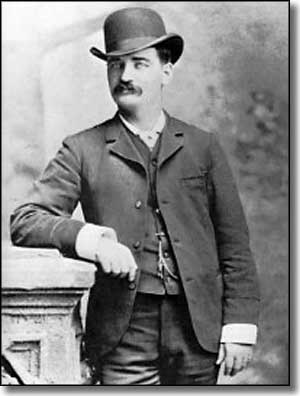
Bat Masterson--Sports Writer


“Bat Masterson said he didn't know anybody Wyatt couldn't whip without his guns. A lot of times Wyatt didn't carry guns...because if he carried guns he had to kill somebody - and he would kill somebody - but he didn't want to. He was a very religious man.”

When we think of Bat Masterson, most of us envision a lawman, a gunfighter--a man's man in the Old West. The television series definitely promoted that image. But did you know that he was also a New York sports writer?

Yep. Not only did he end up being a sports writer, but he wrote for years--as a newspaper reporter and editor as well as for other periodicals--and he'd been doing so since he was a young man. In fact, his ability to write and promote himself is how he pretty much created his own legend.

It all started in Quebec, Canada, on November 26, 1853, when a baby boy named Bartholomew Masterson was born Irish parents. In his teens, the family moved to Wichita, Kansas, and he along with his two of his brothers, Ed and James, went off to seek their fortunes as so many other boys did--buffalo hunting. At age 20, he fought in the Second Battle of Adobe Walls, and then worked for a while as a U.S. Army scout. From 1876 to 1882, he did his gunfight/lawman gig where he rose to notoriety, but our story starts in 1883.

It seems Bat rather enjoyed the sport of boxing. A lot. He was obsessed with fights and was more than fair at pre-fight analysis as well as calling the winners. So good, in fact, that he wrote a sports column for a Denver newspaper called George's Weekly. Newspapermen (and brothers) A.H. and W.E. Lewis had befriended Bat in Kansas City ten years before, and they would play a prominent role in Bat's fame and later success in the East. With their help, he'd honed his writing skills and while he couldn't be called a literary giant, he was pretty good at the craft.

During the years between his gunfighting days and his newspaper career, he mixed a little law enforcement here and there with gambling and writing. He was a professional gambler (called a thoroughbred) and organized boxing matches, acted as referee at times, as bookie, and guard. He never did actually box himself, though. His predictions were often right on, and he was excellent at assessing the fighters, their physical abilities, talent, and motivation.

Bat's life wasn't all roses. He ended up in more than a few altercations when his past reputation would catch up with him, and after a while, also succumbed to the lure of alcohol, although he threw off the demon when he moved to Manhattan. The buzz of New York City suited him just fine and he loved living there. Who would have thought a crusty old gunfighter would take so quickly to city life?

He hooked up with the Lewis brothers again, and he wrote for the New York Morning Telegraph, where he eventually because vice president and secretary. He was close friends with Teddy Roosevelt and other notables, and lived well for the rest of his days.

In 1821, he was writing his column when he had a heart attack and died hunched over his typewriter. The last thing he wrote was, "There are those who argue that everything breaks even in this old dump of a world of ours. I suppose these ginks who argue that way hold that because the rich man gets ice in the summer and the poor man gets it in the winter things are breaking even for both. Maybe so, but I'll swear I can't see it that way."

His last words are evidence that our world really hasn't changed much.

Jacquie
Faery Merry Christmas (a Kindle novella)
Down Home Ever Lovin' Mule Blues (See the Book Video featuring Justin Saragueta)
Jacquie's website * 1st Turning Point * Myspace * Twitter * Facebook
Faery Special Romances * Book Video * Royalties go to Children's Tumor Foundation, ending Neurofibromatosis through Research

Read a book by Jacquie Rogers

Tuesday, March 9, 2010

Stephen Foster

I'll bet there's not a soul who reads this article who hasn't sung a Stephen Foster song. I grew up in a traditional farm community, so he figured in heavily when it came to Grange dances and activities. So who is this guy?

He wrote several hundred songs. He changed the face of music in America to give us our own style. He wrote songs that have endured for 150-plus years, and still going strong. You've heard of Oh, Susanna? He wrote it. How about My Old Kentucky Home? He wrote that. As well as Camptown Races, Old Folks at Home, and my favorite, Beautiful Dreamer. He gave America a new sound and a new respect in the music world.

He was trained as an engineer at Athens Academy in Pennsylvania where he wrote his first composition that was performed in public: Tioga Waltz, which was played at the 1839 graduation ceremony. Athens Academy was near a place familiar to Stephen Foster fans--Camptown Races.

He wrote a bunch of minstrel songs to get his career started. These songs were performed by singers and dancers in black-face, as was the popular comic style in the 1850s. But after ten years of that, he grew tired of the "Ethiopian" style and began to write songs that portrayed black people in a heartfelt, honest way. This is when he wrote Nelly Was a Lady, about a man's grief over his deceased woman. Heretofore, no one had written songs about black people (remember, slavery was still a way of life then) in a humanizing way.

While he was known for writing southern songs, Foster at no time lived in the south. He grew up in Pennsylvania, moved to Cincinnati for a while, and lived his later years in New York.

Very few musicians leave their fingerprints on a country the way Stephen Foster did, but he wasn't a performer so had to rely entirely on sheet music royalties for his income, and he died in poverty.

From Pitt.edu: "Foster's only real income was the royalty he earned on sheet-music sales. Altogether he made $15,091.08 in royalties during his lifetime and almost nothing in performing rights (yearly average was $1,371 for his 11 most productive years). His heirs, Jane and Marion equally, later earned $4,199 in royalties, so that the total known royalties on his songs amounted to $19,290. Today, it would be worth millions."

Sources:
Pitt.edu
PBS: American Experience
Wikipedia
PD Music


Down Home Ever Lovin' Mule Blues (See the Book Video featuring Justin Saragueta)
Jacquie's Website * 1st Turning Point * Myspace * Twitter * Facebook
Faery Special Romances * Book Video Royalties go to Children's Tumor Foundation, ending Neurofibromatosis through Research


Read a book by Jacquie Rogers

Wednesday, February 10, 2010

Zeus and Hera


The gods and goddesses on Mt. Olympus have provided us with entertainment for thousands of years. One of the more interesting couples was Hera and Zeus, the children of Rhea and Cronus.

Hera and Zeus may not have had the most loving romance of all time, but they certainly kept life exciting. Zeus drew the long straw so he had the honor of being the ruler of heaven and earth. Hera was the goddess of childbirth and marriage. She was the supreme goddess on Mt. Olympus.

Theirs was an arranged marriage, one which Hera managed to avoid for three centuries. She wanted nothing to do with a god who was a womanizer, even if he was her own brother. Worse, he swallowed his first wife, Metis, a Titaness. That's just never a positive foundation for a loving marriage.

Finally Hera relented--only after Zeus tricked her by shifting into a cute little bird. Once she had him nestled in her bosom, he shifted back to his man form and made mad, passionate love to her. Once again he proposed, and this time she agreed. A lavish wedding followed, and almost immediately Zeus went back to his philandering ways.

Her reservations about his character were well founded. Zeus fathered many offspring, three by Hera: Ares, Hepheseus, and Hebe. Affairs with other women produced the twins Artemis and Apollo, Dionysus, Hermes, Athena, and Persephone. Also of note are Perseus, Herakles, The Muses, Minos, and Helen, among many dozens of others. So Zeus was a busy guy, and Hera wasn't all that thrilled with the situation. A bit jealous, you might say.

She banished Leto, pregnant with Zeus' twins, Apollo and Artemis, to Delos and then prevented the Goddess of Childbirth from attending her, forestalling the birth. Other goddesses felt sorry for Leto and bribed Hera with a golden necklace. She finally relented and allowed Leto to give birth.

Io didn't fare very well, either. When Hera nearly caught Zeus in flagrante delicto with Io, Zeus turned his lover into a white heifer. Hera wasn't a bit fooled, and to make a long story short, sent gadflies to pester Io, who ran and ran until she reached Egypt, where she became Isis.

I've mentioned a cursory scan of the events but most stories, as bawdy or salacious as they may seem, all have a lesson to teach, or explain nature in some way. Very few are for entertainment value only, although a more fascinating cast of characters would be hard to find.

And whether Hera and Zeus every settled into a Happily Ever After, I don't know. But what a wild ride!

Sources:
Marriages of the Gods, a Storybook by Erika Mitchell-DeLuca
The Loves of Zeus
Theoi Greek Mythology
Wikipedia: Hera
Wikipedia: Zeus


Jacquie

Down Home Ever Lovin' Mule Blues (See the Book Video featuring Justin Saragueta)
Jacquie's Website * 1st Turning Point * Myspace * Twitter * Facebook
Faery Special Romances * Book Video Royalties go to Children's Tumor Foundation, ending Neurofibromatosis through Research


Read a book by Jacquie Rogers

Saturday, December 12, 2009

The Seasons: Chinese Moon Festival

By Jacquie Rogers

The Chinese Moon Festival is an ancient festival over 3,000 years old, and is celebrated in autumn, the 15th moon day of the month of the Chicken. It's the night of the full moon, of abundance, the festival to honor family ties and romantic relationships. Families, even those divided by oceans, try to come together during this time. But if a family or a couple is unable to unite, separated by hundreds or thousands of miles, they can still share the moon on that night and be together.

Legends

There are four legends primarily associated with the Moon Festival: the story of the lady, Chang Er (or Chang'e); of the man, Wu Kang; of the hare, Jade Rabbit;, and of the Moon Cake.

Chang Er was the wife of Hou Yi who shot down nine of the ten suns that were scorching the earth. As a reward, Hou Yi was given the elixir of immortality for himself and his wife. When villains tried to steal it, they killed Hou Yi, and Chang Er swallowed the elixir so the bad guys wouldn't get it. Turned immortal, she flew to the moon, where she lives to this day. There are many versions of this story, one of the nicest told on Laputan Logic, where links to several other versions are given as well.

Wu Kang's story is also about immortality. He was a man who sought challenges, and hopped from job to job to find new adventures, until he decided the greatest adventure of all would be immortality. He headed for the mountains to study under an immortal. Not one area of study could hold Wu Kang's interest, though, so the immortal got frustrated and told Wu Kang to chop down the cassie tree, and he couldn't return to earth until he did. But the cassie tree grew back to its full size if it wasn't felled by sundown. Since the job couldn't hold his attention, Wu Kang never did keep on task to fell the tree in one day, so to this day, he's still on the moon, chopping on the cassie tree.

The Hare didn't fare so well, but is well-remembered. A hungry old man needs food. A monkey, an otter, and a fox, hoping to do a good deed, each offer the man some food, but the hare, knowing he has nothing to offer but himself, throws himself into the fire and cooks himself. The old man was really a monk, and in gratitude, gave the Jade Rabbit immortality on the moon, where he serves Chang Er even now.

Moon Cakes are the newest legend of the Moon Festival. It is said that in the 14th Century, when the Chinese were ruled by the Mongols and assembly was illegal, that the fomenters of revolution passed their plans and instructions to the people inside moon cakes. On the night of the festival, the people revolted and thus began the Ming Dynasty.


Celebration


The festival is at harvest time, a time of bounty, and celebrated by a family feast similar in spirit to the modern Thanksgivings of Canada and the USA. Moon cakes, filled with bean paste, meat, lotus seeds, or a few other popular foods, are both given and traded. It's a time filled with joy. and the children love getting to stay up until the wee hours during the lantern parade--and are especially delighted if they get to carry a lantern in it.

I'm using the Chinese Moon Festival as a ticking clock in my novella, Faery Hot Dragon. It's a time for lovers to sit on hilltops gazing a the moon. And perhaps other things. :) A perfect opportunity for a romance novel!

Whatever the season, have a happy one!

Jacquie
Faery Merry Christmas (a Kindle novella)
Down Home Ever Lovin' Mule Blues (See the Book Video featuring Justin Saragueta)
Faery Special Romances * Book Video * Royalties go to Children's Tumor Foundation, ending Neurofibromatosis through Research
Jacquie's website * 1st Turning Point * Myspace * Twitter * Facebook


Monday, October 19, 2009

Research: 12th Century Armor

When I wrote Faery Much In Love, a short story in Faery Special Romances, I knew very little about 12th Century Europe, let alone about the specifics of armor. To lend authenticity, I had a lot of work to do. Here's what I learned about the nuances regarding armor and defense of this century.

Misconceptions

When most of us think of armor, we think of the full plate armor of the 16th Century, which soon became obsolete with the introduction of firearms. But armor took many hundreds of years before it finally evolved into such finely tuned equipment. One of the first things I learned was that my knight needed a bit more armor than was actually used in 1199 A.D., so my 12th Century knight wears late-13th Century armor. So far, no one has noticed (and now you know my secret). :)

But back to the 12th Century . . .

Before we get into the specifics, we need to know the weapons in use. Swords were the weapon of choice but very expensive. A warrior carried his sword in a sword belt worn around his waist, and sported a diamond-shaped shield held by a shoulder strap on his back. Crossbows came into popularity along about this time, as well as the Welsh longbows. Infantrymen used spears and whatever else they could afford and/or carry; and the cavalry, which became vitally important in this century, carried heavy maces as well as swords, and sometime battleaxes.

Well, then, what did they wear?

So the armor had to defend primarily against swords, arrows, spears, and maces. Let's take a look at some of the individual pieces of equipment.

Mail

Warriors used mail since the 4th or 5th Century, so it was nothing new. Skilled armorers created complicated hauberks, chausses, and even gauntlets out of mail. Under the mail, they wore heavy quilted garments to protect their skin from the rough mail, and also to cushion the blows from their enemies' weapons. Mail protected against slashing, but not piercing, nor did it protect against bone-crushing strikes.

We'll talk a little about most of the parts of armor.

Helm

In the picture to the right, we see he's wearing a steel helm (or bascinet) with mail to protect his throat and neck, with no facial protection other than a bar over his nose.

Hauberk

A hauberk is a mail shirt, usually long-sleeved and knee-length, with a slit up the front and back so the warrior could ride a horse. It's made of iron wire, was very expensive, required a lot of maintenance, and was quite heavy. (Remember, your knight will be wearing a heavy quilted shirt underneath the mail hauberk.)

Gauntlets

Gauntlets were worn over the hands. Gloves, if you will. They were sometimes made of mail but leather gauntlets were more common in the 12th Century.

Chausses

Chausses were leg protection made of mail, and very similar, although more form-fitting, to cowboy's chaps of today.

Sabaton

To protect their feet, warriors wore sabatons. These chain mail foot coverings extended past the toes and ended in a point. This grew longer and longer over the years, and toward the end of the armor era, some classes could wear sabatons with toes two and a half feet long!

Plate armor

Nope, not in the 12th Century. Sometimes plates of heavy leather were sown together and worn over the mail hauberk, and in the 13th Century, they started wearing plates of steel armor attached in much the same way, but the mail hauberk was still the main piece of equipment.

Pros and Cons

The advantage of 12th Century armor over later armor is that these knights were much more agile and mobile. The disadvantage is that they weren't nearly as well protected as the 15th and 16th Century warriors. In any century up until modern times, warriors had to buy their own armor, and a good suit cost more money than most common men would see in a lifetime.

Sources
European Historical Overview by David Kuijt
12th Century Arms and Armour

Jacquie

Down Home Ever Lovin' Mule Blues (See the Book Video featuring Justin Saragueta) Jacquie Rogers * Myspace * 1st Turning Point * Twitter * Facebook
Faery Special Romances * Book Video * Royalties go to Children's Tumor Foundation, ending Neurofibromatosis through Research

Wednesday, September 16, 2009

Faery Merry Christmas


'Tis the season for reading Christmas stories! And I have one for you. :)

Faery Merry Christmas


Details (blurb and buy link) coming soon!

Jacquie Rogers

Down Home Ever Lovin’ Mule Blues (See the Book Video featuring Justin Saragueta)

Faery Special Romances (See the Book Video)

Royalties donated to Children’s Tumor Foundation, ending Neurofibromatosis through research

Website *** 1st Turning Point *** Myspace *** Twitter *** Facebook

Friday, August 28, 2009

Please Help Find a Cure for Neurofibromatosis

As many of you know, my daughter and her two daughters have neurofibromatosis (NF), a genetic disorder in which tumors grow on nerve endings all over the body, inside and out. These tumors are disfiguring at the least, and debilitating and sometimes fatal at their worst. Our family is commited to NF awareness and research, hoping one day to end this dreadful disorder.

To that end, here's a message from John Risner, president of the Children's Tumor Foundation
http://www.ctf.org


I am sending this email to all supporters of NF research to ask for their help this year. We are proud of the advances in NF research that we have been able to be a part of, but we readily acknowledge that federal funding has been critical to this progress. In 1996 neurofibromatosis (NF) was added to The Congressionally Directed Medical Research Program (CDMRP)as one of eight disease groups. Since then this program has funded over $125 million in NF research and has been the driving force in the development of NF cell lines, drug target identification, animal model development and now is moving into clinical trial funding.

The House of Representatives included a $25 million appropriation for NF research as part of the CDMRP for FY2010. This restores the program to its FY2005 level, which had declined to $10 million in FY2009. The Senate will begin their deliberations on this bill when they return after Labor Day.

I am writing to ask you to take five minutes in the next two weeks to contact your Senators to ask for their support. A personal letter, faxed or mailed, has the most impact, but calls and emails will help as well. While all voices are important, the Senators below are members of the Appropriations Committee and key subcommittee. If you live in one of these states, your letters and calls are particularly important.

Key points to include in your communications are to thank them for the Senate's past support of this vital program, and ask for their support this year to preserve the $25 million that is included in the House budget. A history of our advocacy program, recent updates and sample letters for downloading can be found on our website at http://www.ctf.org/How-You-Can-Help/advocacy.html.

Thank you for your past support. I hope you will take the time not only to act on this modest request, but to leverage your action by forwarding this email to family and friends and ask them to join you. The more supporters that reach out to their Senators, the greater our chances of preserving this vital funding.

If you have any questions about our advocacy program, or the legislative process for NF research, please don't hesitate to contact me by phone or email.

Best regards,

John Risner, President
Children's Tumor Foundation
Ending Neurofibromatosis Through Research
95 Pine St. 16th Floor
NY NY 10005
212 344-6633 x249
http://www.ctf.org


Democratic Subcommittee Members

* Senator Daniel Inouye (Chairman) (HI)
* Senator Robert C. Byrd (WV)
* Senator Patrick Leahy (VT)
* Senator Tom Harkin (IA)
* Senator Byron Dorgan (ND)
* Senator Richard Durbin (IL)
* Senator Dianne Feinstein (CA)
* Senator Barbara Mikulski (MD)
* Senator Herb Kohl (WI)
* Senator Patty Murray (WA)
* Senator Arlen Specter (PA)

Republican Subcommittee Members

* Senator Thad Cochran (MS)
* Senator Christopher Bond (MO)
* Senator Mitch McConnell (KY)
* Senator Richard Shelby (AL)
* Senator Judd Gregg (NH)
* Senator Kay Bailey Hutchison (TX)
* Senator Robert F. Bennett (UT)
* Senator Sam Brownback (KS)

~~~~~

It's me again. :)

My daughter recently married, despite the very real possibility that she's spend the rest of her life alone. People with tumors all over their bodies aren't prime candidates in the marriage mart, after all. You can read all about it and see some pictures here:
http://www.textyladies.com/2009/08/24/romance-is-in-the-air/


Down Home Ever Lovin' Mule Blues (See the Book Video featuring Justin Saragueta)
Jacquie Rogers * 1st Turning Point * Myspace * Twitter * Facebook
Faery Special Romances * Book Video * Royalties go to Children's Tumor Foundation, ending Neurofibromatosis through Research

Read a book by Jacquie Rogers